
Small Medium Enterprises (SMEs) have been one of the most significant contributors to Singapore’s national economy. As of 2022, SMEs make up 99 per cent of Singapore’s domestic enterprises, with a Gross Value Add (GVA) of 44 per cent while employing more than 70 per cent of the local workforce. As such, the government has been committed to providing support to SMEs in Singapore through various avenues – such as grants, tax incentives and financing tools – to ensure that the industry continues to grow. However, how do SMEs in Singapore leverage these opportunities for their business growth?
We focus on diving into the different government support for SMEs in Singapore to share how SMEs can leverage these initiatives effectively.
Singapore’s S$30 billion reinforcement into the SME industry
SMEs in Singapore can find a multitude of government support even before the height of the pandemic when most businesses suffered major losses due to the lockdown. In fact, between 2019 and 2022, Singapore’s Minister of State for Trade and Industry, Low Yen Ling, reported that S$30 billion had been invested to support SMEs, including the additional assistance provided during the COVID-19 pandemic. Many of these government support initiatives have recently focused on the globalisation of these enterprises. Their goal is singular: to ensure stable growth and expansion to new markets beyond the constraints of a small domestic market on the island nation.
On top of that, the government has also increased their investment in other strategies, such as the SME Co-Investment Fund, and the Singapore Global Enterprises initiative – an initiative concentrated on SME innovation, internationalisation and partnerships. Finance Minister Lawrence Wong assured the SME industry that the government will remain steadfast in their support by:
- Delivering customised capability enhancement programs designed to meet the unique requirements of each corporation
- Collaborating with subject matter experts to reinforce the most essential members of the leadership team
- Expediting the process of globalisation and global expansion
- Building robust talent pipelines
Government support for SMEs in Singapore does not end there. Bolstered by EnterpriseSG, alongside other various trade associations and chambers in the country, Singapore has established 11 SME centres around the city-state to take on the crucial role of boosting the chances for local enterprises to pursue global opportunities. One such example of SMEs benefiting from this backing is the 55-year-old Nyonya kueh business Lek Lim Nonya Cake Trading, where the enterprise was able to penetrate the Australian market, with plans to consequently expand into the British market. Other than providing training and workshops to fortify business operations and capabilities, the SME centres have also helped to catalyse a change in mindset for the business, empowering them to take risks to grow out of their shell.
The indispensability of internationalisation of SMEs in Singapore
According to Low, the logical next steps for SMEs in Singapore are the global expansion and internationalisation of the business. Considering the limited domestic market size, Low also added that internationalisation is more than just an option; companies should not limit themselves to only the local context and should be encouraged to grow their business and “compete on a global scale” despite the oncoming challenges they may face.
While SMEs undergo rapid digitalisation across all industries, which eases the process of scaling up a business into international markets, globalisation does not come without its own set of challenges. Some of the biggest hurdles SMEs may face are increased competition as well as logistics and supply chain issues. Expansion into new markets usher in new target markets, requiring more research into new cultures and target audiences with different customer behaviours and preferences. Other than that, with more spread-out operations in different markets, this can subsequently aggravate any logistics and supply chain issues without lengthy consideration beforehand.
Despite these aforementioned challenges and more, SMEs in Singapore should examine the numerous benefits of internationalisation, especially its impact on the enterprise’s future. One of the key opportunities that opens up with globalisation is market expansion, leading to new opportunities for new clients as well as international investors. This, in return, will encourage Singapore’s economic growth in addition to uncovering a wider talent pool for the growing companies.
How does the government support SMEs in Singapore?
- GoBusiness IP Grow platform
One of the more recent innovative rollouts by the Singaporean government in support of SME internationalisation is the GoBusiness IP Grow platform. An essential tool for companies scaling up, the GoBusiness IP Grow platform safeguards their commercial interests as SMEs undergo globalisation. This includes the protection of intellectual property and proper management of intangible assets like company brands, in-house technology, as well as their knowledge and information. As these assets are non-physical, their safekeeping is easily overlooked, which compelled the creation of the platform.
Case Study: VertisPro
Illustrating the significance of the GoBusiness IP Grow platform, consider the case of VertisPro. VertisPro is a Singaporean health-tech company that serves to connect patients to the right treatments and clinical trials with the latest and most effective solutions available. The company wanted to take their solution into new markets, which started its process of leveraging the GoBusiness IP Grow platform. The platform’s e-advisor tools provided VertisPro with access to top-notch advice on safeguarding intellectual property, including details on trademarking, information on related grants, and a comprehensive directory of local firms to catalyse the business processes. As such, the company shortlisted three vendors to inquire further to help them kickstart the exercise of acquiring trademark protection.
- Market Readiness Assistance (MRA) grant
Another one from Singapore’s extensive list of SME support is the Market Readiness Assistance grant, which focuses predominantly on defraying the costs of consultancy, overseas market promotion, business development and business set-up. This grant is especially helpful for SMEs who are new to a target overseas market, as it aims to encourage excursions beyond the national restraints. The following are some of the costs covered in the grant as well as the criteria for grant eligibility:
What is covered
- Up to 50% of eligible costs for local SMEs
For supported activities, capped at S$100,000 per company per new market, which include:
- Overseas market promotion (capped at S$20,000)
- Overseas business development (capped at S$50,000)
- Overseas market set-up (capped at S$30,000)
- Each application is limited to one activity in a single overseas market
Eligibility
- Business entity registered and operating in Singapore
- Company has at least 30% local equity held directly or indirectly by Singaporean(s) and/or Singapore PR(s), determined by the ultimate individual ownership
- New to target overseas market
- The company’s annual sales in the target market must not have exceeded S$100,000 in any of the preceding three years
- Company has a Group Annual Sales Turnover not exceeding S$100 million OR a Group employment size not exceeding 200 employees
The enhanced MRA grant cap of up to S$100,00 has also been extended to 31 March 2025. For more information on the application process, visit their website here.
- Double Tax Deduction for Internationalisation (DTDi)
Other than grants, government support for SMEs in Singapore includes the Double Tax Deduction for Internalisation, allowing qualifying businesses, including e-commerce-related activities, to receive support in four different categories:
- Market Preparation
- Market Exploration
- Market Promotion
- Market Presence
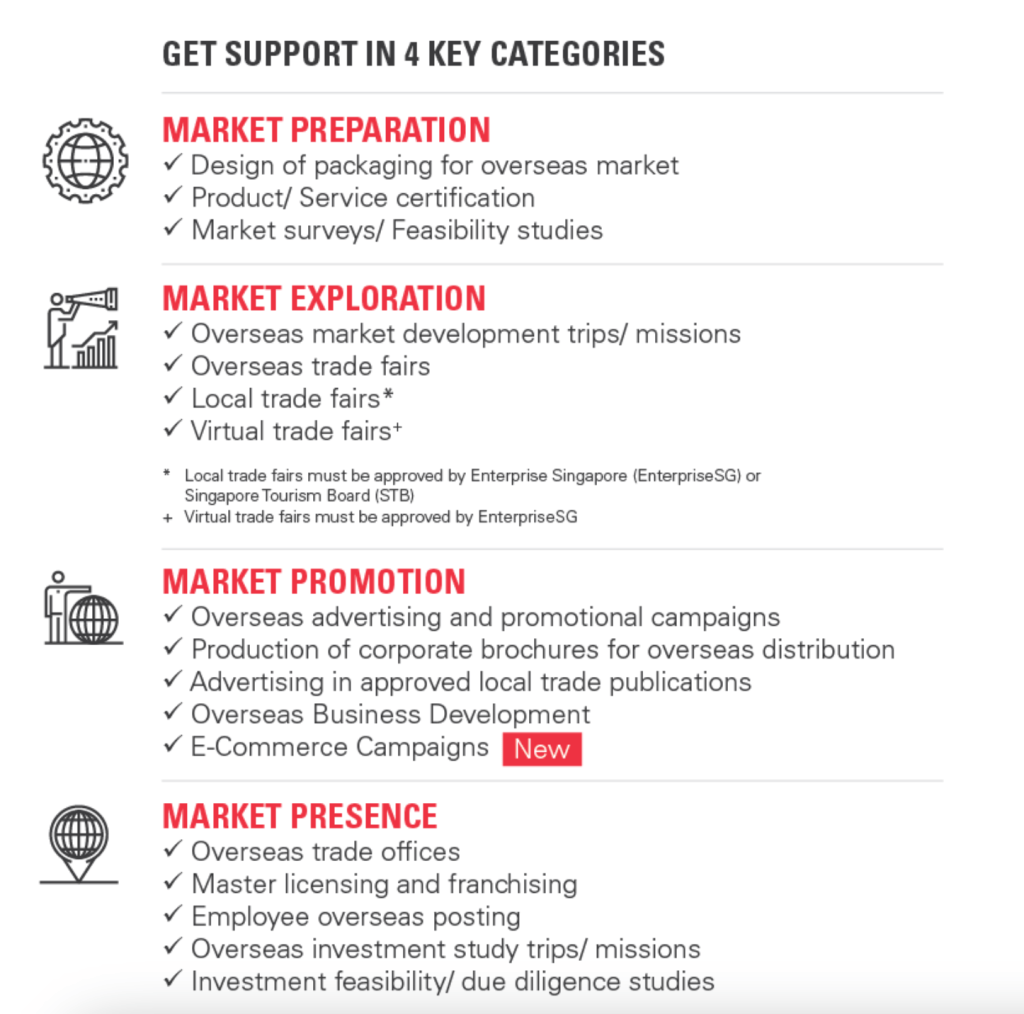
Image source: EnterpriseSG
We have listed below the criteria for companies to be eligible for this benefit:
- Business entity resides in Singapore with a primary purpose of promoting the trade of goods or provision of services
- Businesses enjoying discretionary incentives¹ may also be allowed to qualify for the DTDi scheme on a case-by-case basis, subject to approval by EnterpriseSG or the Singapore Tourism Board
- Incentivised businesses must have their global headquarters in Singapore, with the primary purpose of trading in goods or providing services, and have an intention to internationalise.
- Project must meet the following key objectives:
- Promotes the company’s new products and services to new target market(s)
- Identifies new customers in target market(s) for the company’s existing products and services
- Promotes the company’s new products and services to existing customers
- Promotes the company’s existing products and services to existing markets so as to increase market share
- Applications must be submitted on the DTDi portal prior to starting the project.
EnterpriseSG has also provided a few case studies on how enterprises can benefit from DTDi as they embark on their journey towards globalisation. Find out more about this and the application process by visiting their page here.
- Enterprise Financing Scheme (EFS)
Last, but certainly not least, the Enterprising Financing Scheme is also offered by the government agency to SMEs to help companies finance their projects at a variety of different stages and cater to a wide variety of needs, such as working capital needs, green growth projects, acquisition for internationalisation, and trade needs. Several types of loans under the scheme, including the Trade Loans and Working Capital Loans, were previously extended to March 31, 2024. Read their EFS page for the most recent updates on eligibility requirements and the application process.
As observed in the business development and investment trends in SMEs in Singapore, enterprises should expect more support from the government which will ultimately encourage them to steer their businesses to penetrate foreign markets in the next few years. Due to various factors, including the limitations of the local market on top of the growing potential of businesses amidst digitalisation, SMEs need to leverage the resources and support from the government and prepare for bigger and better opportunities beyond the local context. The extensive government support also underscores Singapore’s commitment to the growth of the SME industry and its unwavering trust in the competitive potential of local entrepreneurs, creating an ideal environment for even greater ambitions.


 The Next Idea
Leave a comment