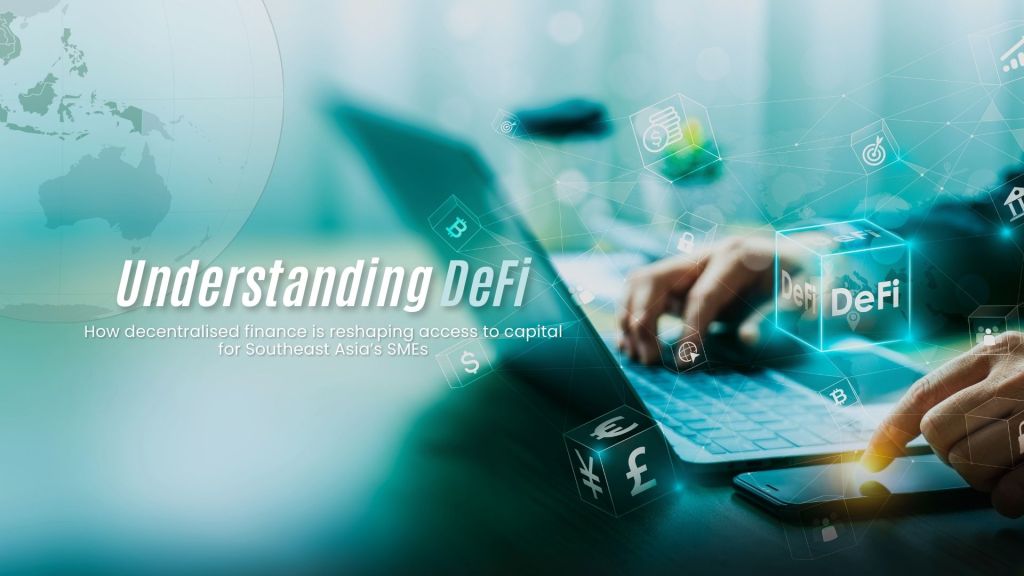
Everyone knows that small and medium-sized enterprises form the backbone of Southeast Asia’s economy. With over 70 million of such businesses in the region that contribute around $1.5 trillion to its GRP, SMEs impact is not to be taken lightly. Millions of Southeast Asians benefit from SMEs in the region, be it through the product and service offerings, or through employment opportunities. However, even though every Tom, Dick and Harry may understand the importance of SMEs to Southeast Asia, SMEs are facing an uphill battle that comes with the limitations of their size and scale of operations compared to their bigger competitors.
Don’t get me wrong – governments in Southeast Asia have introduced support for SMEs. However, traditional financial institutions like banks that execute these policies tend to implement them with heavy or hidden T&Cs to qualify. Think of complex application processes, or substantial collateral that SMEs will find challenging to overcome. This leaves SMEs struggling to access funding opportunities for expansion, investments, or protection against market instability.
Financial challenges faced by SMEs in Southeast Asia
Limited access to formal credit
Exploring in further detail, formal financial institutions in Southeast Asia have historically underserved SMEs. Financial institutions require high collaterals, a robust credit history and additional credit information to justify lending large amounts of capital that are crucial for SMEs.
Many SMEs tend to be new and informal in the business environment, which leads to them missing the mark on satisfying these requirements. Compared to more established firms and businesses, 70% of SMEs are unable to borrow loans as they tend to lack a comprehensive credit history and rely heavily on movable assets, which can lock them out of some loans’ eligibility. Understandably, this makes lenders and banks reluctant to provide the capital SMEs need as they are unable to assess SME’s financial health in greater detail.
High-interest rates and short loan tenures
With global economic conditions becoming uncertain, government monetary policies are changing. Considering that SMEs are generally perceived to bear higher risk, financial institutions are only comfortable with granting SME loans that have high-interest rates and short loan tenures to compensate for it. This further strains the already limited financial bandwidth of SMEs.
Reliance on informal lending
In such cases where formal options are scarce and nearly impossible to access, naturally, business owners will turn to family, friends, or even their own pockets to sustain the businesses. There are many situations where SMEs will rely on informal sources like NGOs or local moneylenders too. However, this temporary solution can potentially exacerbate the situation because these informal sources charge exorbitant interest rates. This means that SMEs are eventually perpetuating the debt cycle that they’ve landed themselves in, always playing catchup to pay back loans, and thus reaping marginal profits. This is especially bad news if they are looking to grow and scale.
How DeFi solves these problems SMEs face
Decentralised finance (DeFi) has recently made waves among the business ecosystem as a potential financial solution. First introduced in 2017, DeFi is a financial system leveraging blockchain technology, primarily Ethereum, to create financial services that eliminate intermediaries such as banks and brokers. This manifests into creating peer-to-peer lending platforms and decentralised exchanges (DEXs). Unlike traditional financial systems that act as gatekeepers, financing capital is now at closer reach, potentially opening doors for 40% of underserved SMEs in Southeast Asia.
The core principles of DeFi are built on the following factors:
- Transparency: All transactions are made to be visible on the blockchain, recorded on a public ledger for anyone and everyone to see so long as they have an internet connection.
- Accessibility: DeFi operates on a “permissionless” basis, with protocols that allow SMEs tap into financial services at lower transaction costs. This focus on financial inclusion allows underserved and previously excluded communities to receive capital easily.
- Decentralisation: DeFi allows users to bypass intermediaries and directly interact with each other, eliminating additional barriers to lending and borrowing money.
Potential advantages of DeFi for SMEs
Improved access to capital
As aforementioned, DeFi platforms are a viable alternative for SME funding, because they focus on removing the stringent requirements that traditional banks and lenders impose. Decentralised lending platforms such as Aave and Compound empower businesses to secure loans that are based on cryptocurrency collateral, instead of traditional credit assessments that SMEs normally lose out to.
Lower transaction costs
Traditional cross-border payments and remittances often involve layers of bureaucracy with multiple financial institutions, each of which charge their own fees that can accumulate to large additional costs for SMEs who operate at a regional level.
Fortunately, DeFi facilitates direct value transfers with minimal fees, regardless of where SMEs operate in, allowing them to potentially expand their offerings internationally. This is crucial for SMEs who are looking to expand their market operations, obtaining more revenue and improving their competitiveness down the line.
Enhanced financial inclusion
DeFi is open-access in nature, which means that SMEs can access global liquidity pools and participate in the global market. So long as an internet connection is established, DeFi can financially include underbanked and unbanked SMEs, accelerating their integration into the larger economic system.
Risks and obstacles in adopting DeFi solutions
Regulatory uncertainties
A main point of concern that Southeast Asian economies face is the regulations put in place for DeFi platforms to operate in. While some countries like Singapore have taken more proactive measures to crypto regulation, others maintain ambiguous positions or limit them. This could make compliance for SMEs rather difficult.
Without clear frameworks in place for DeFi activities, SMEs might unintentionally put themselves at legal risk, which can be perceived as a worse outcome than relying on traditional financing options. Hence, it is essential for Southeast Asian markets to be clear in order to encourage more widespread adoption of DeFi.
Security concerns
Not all solutions may be foolproof, and DeFi is largely vulnerable to exploitation. DeFi platforms are at risk of cyberattacks, which can lead to a loss of millions of dollars. Especially since blockchain transactions are made to be irreversible, any funds that are lost through hacks or human error are difficult to recover. This can be problematic for SMEs that have limited technical expertise, or with tight financial margins.
Market volatility
Market volatility can be problematic for businesses who use crypto accounts and transact on DeFi platforms. Crypto assets are volatile to market fluctuations, and if the market is dipping, it is extremely difficult for SMEs to liquidate their crypto assets in a short span of time. This means that SMEs would be even more vulnerable to liquidity crises.
Navigating the DeFi landscape
DeFi tech will definitely mature and find its footing in the years to come. This means that more robust and sustainable DeFi solutions will come into the picture as well.The global DeFi market is expected to reach $352 billion by 2031, driven by the need for more efficient payment solutions for businesses and individuals. For SMEs, this is good news – soon, there will be curated and tailored ways for SMEs to stay financially afloat.
Engaging with local fintech communities and following reliable information sources are good places for SMEs to start if they want to learn more about DeFi. Before delving deeply, it is essential to comprehend the workings and possible advantages of DeFi. In order to maintain smooth operations, SMEs also need to stay up to date on regulatory changes to guarantee adherence to local and regional laws.
The true potential of DeFi for SMEs in Southeast Asia will take time as technology and the understanding of it evolves, however forward-thinking SMEs that do their due diligence and risk assessment will be able to take advantage of the market and scale sustainably in the long run.

 The Next Idea
Leave a comment