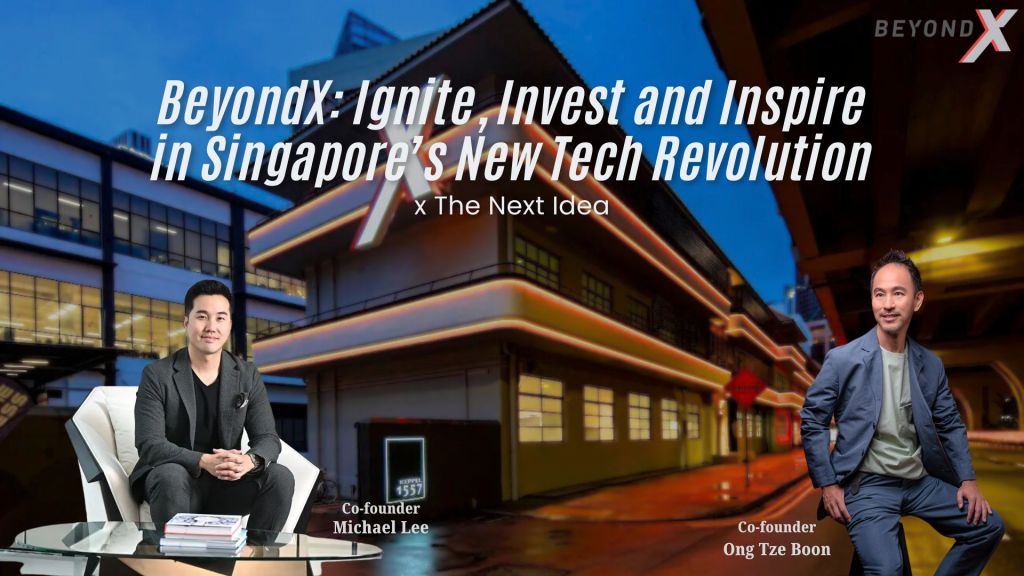
Singapore’s latest addition to its innovation ecosystem, BeyondX Living Lab & Incubation Space, is more than just another co-working venue or tech hub. It is an intentional experiment in cross-sector collaboration, digital disruption, and sustainable scale designed to serve not only founders, but the broader SME landscape that powers Southeast Asia’s economic engine.
At a time when small and medium enterprises account for over 97% of all business establishments in the region, the need for accessible innovation infrastructure has never been greater. BeyondX addresses this by offering startups and growing SMEs an integrated environment where capital, creativity, and community intersect. Its goal: to lower the barriers to entry for bold ideas, equip entrepreneurs with strategic resources, and catalyse a new wave of homegrown solutions that can scale beyond Singapore.
At the centre of this ambition are co-founders Michael Lee, founder of the Hustle & Bustle Group, and Ong Tze Boon, Executive Chairman of ONG&ONG. Both men bring decades of insight from their respective domains, immersive experiences and architecture to forge a space they believe could define the next decade of Southeast Asia’s startup landscape.
The startup that doesn’t just talk about impact, but embeds it
For Lee, whose work with Hustle & Bustle has long prioritised immersive experiences with social value, BeyondX isn’t trying to force a ‘socially conscious’ identity on its residents. Instead, it creates an environment where impact becomes ambient. “You’re working in a space where people from totally different sectors are building side by side. That changes how you think,” Lee notes. The proximity to others building for healthcare, sustainability or education makes it almost impossible for founders to ignore the wider consequences of what they’re creating.
This approach mirrors a global trend. According to a 2024 McKinsey report, over 60% of Gen Z founders now prioritise purpose alongside profit when launching ventures. BeyondX provides the conditions for that intention to mature into viable, scalable companies not through slogans, but through daily exposure to diverse ideas and disciplines.
Why storytelling may be the most underrated tool for SMEs
When asked about the role of storytelling in startup and SME growth, Lee is quick to point out that authenticity outperforms polish. “It helps when the story comes from a real place, not something made just to impress. It gives audiences a reason to care,” he shares. That belief has underpinned Hustle & Bustle’s own success and is now being passed on to the startups working within BeyondX.
Storytelling is increasingly acknowledged as a strategic asset in early-stage ventures. Research by Stanford shows that startups with a clearly articulated brand story are 22 times more likely to be remembered by investors and consumers. For young founders, Lee believes that clarity of narrative helps align teams, focus product design, and accelerate traction. “It can be the thing that brings focus whether it’s in branding, pitching, or just getting the team on the same page.”
Rewriting how partnerships happen in Singapore’s startup and SME economy
Ong and Lee both emphasise the importance of the environment when it comes to cross-sector collaboration. BeyondX, by design, removes the silos that typically separate academia, corporates, creatives and technologists. “These are not partnerships you can force, but you can design environments where they become more likely,” says Lee. The idea is to engineer serendipity: an AI founder bumps into a climate researcher, or a student-led team sparks ideas in a corporate executive.
This model is not without precedent. Silicon Valley’s early success was catalysed by the mixing of Stanford talent, defence dollars, and commercial ambition. Singapore, with its dense geography and pro-innovation policy stack, is well positioned to replicate a more intentional version of that.
The ‘ignite, invest, inspire’ philosophy behind BeyondX
BeyondX operates on a deceptively simple framework: ignite, invest, and inspire. Ong, drawing on his deep leadership experience in the Architecture, Engineering and Construction (AEC) sector, frames this triad as a practical blueprint. “In every successful business, there’s a creative, an operator, and a money-maker. The best companies align these roles from the start,” he explains.
BeyondX provides that scaffolding. It helps founders find product-market fit (ignite), connects them with investors (invest), and offers platforms to amplify their presence (inspire). “What’s the point if nobody hears about it? You’ve got the best invention, then what? You need a marketplace or you create your own,” Ong adds.
The incubator is also planning ‘BeyondXpo’, an innovation showcase where ideas move beyond the lab and into public view. The goal is not just visibility, but inspiration encouraging a wider community to engage with emerging technologies and entrepreneurial thinking.
From the pyramids to phygital: Ong’s vision for bridging tradition and technology
Ong’s views on innovation are steeped in both history and pragmatism. “Even when the Egyptians built the pyramids, I’m sure there was an architect who drew those lines,” he quips. His point is clear: architecture and construction have always been at the bleeding edge of problem-solving, even if the tools have changed.
What excites him today is the intersection of physical and digital, what he calls “phygital” solutions. From robotics to AI-driven design automation, he sees BeyondX as a sandbox where legacy sectors like AEC can be meaningfully augmented by emerging tech. “We’re not a startup AEC space, but we need to augment it with all the digital stuff,” he notes, underlining the need for industries to evolve without discarding their foundations.
Building sustainably from day one
The challenge of sustainability, both environmental and operational, is one BeyondX does not treat as an afterthought. According to Ong, many early-stage companies overestimate the importance of the ‘invention’ and underestimate the need for alignment. “Entrepreneurs often focus too much on the first 1 per cent: the invention, and not enough on the remaining 99 per cent, which involves alignment, communication, and scaling,” he explains.
The space also addresses sustainability in design thinking. By placing founders in a community where tough questions are asked, such as who benefits, what’s the downstream impact, startups are encouraged to bake in responsibility from the beginning. “You are not just building in a vacuum,” adds Lee. “You’re surrounded by people who challenge your assumptions.”
Ong makes a compelling analogy with EVs: while electric vehicles still depend on carbon-generated electricity in many cases, shifting from 1,000 small engines to one large one is still a net gain. In his view, the same applies to startups. Sustainable choices may not be perfect but they’re necessary steps in the right direction.
A new kind of incubator for a new kind of founder
In Singapore’s crowded innovation landscape, BeyondX stands out not because it claims to be different, but because it behaves differently. It does not try to manufacture innovation rather it curates the conditions under which innovation becomes more probable. Whether by encouraging cross-sector collaboration, supporting thoughtful scale, or rethinking sustainability, the Living Lab feels like a blueprint for what startup ecosystems in the 2030s could look like.
And with its founders committed to not just launching companies, but shaping culture, BeyondX may well become a keystone in Singapore’s next chapter of technological and social transformation.

 The Next Idea
Leave a comment