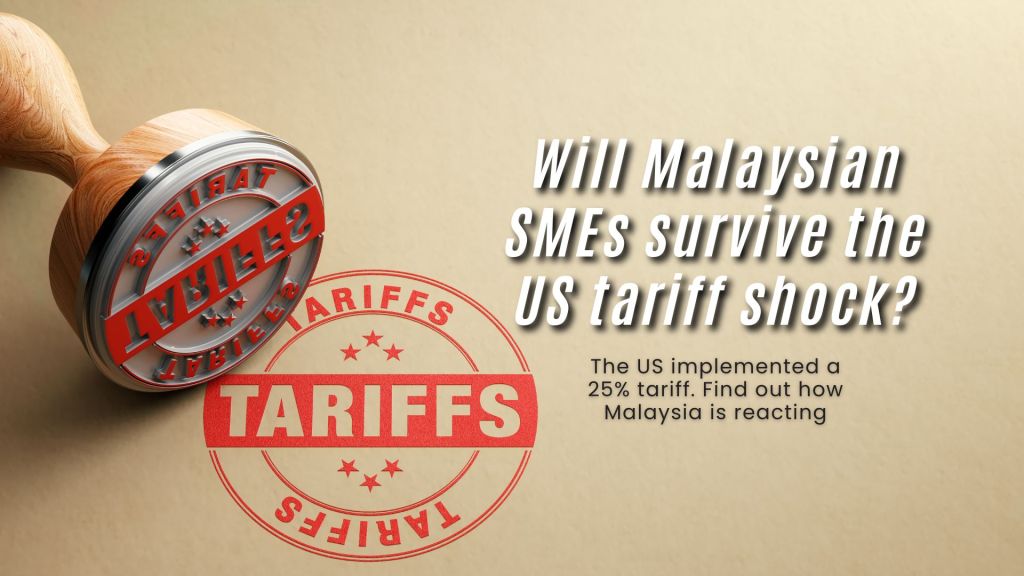
The latest announcement of a sweeping 25 per cent tariff on Malaysian goods entering the United States has sent a somewhat shocking moment through Malaysia’s SME community. For many of us, reading and hearing the news came both as a diplomatic jolt and a stark economic reckoning.
The Small and Medium Enterprises Association of Malaysia (SAMENTA) was quick to call this an impending “economic earthquake.” See, as the global economic axis tilts yet again, Malaysian policymakers and businesses need to ask themselves urgent questions and address them.
Is Malaysia’s SME sector resilient enough to withstand this blow? What kind of immediate action is needed, and more importantly, what long-term reforms must be prioritised to reduce overexposure to external trade shocks?
A vulnerable pillar of the economy
Malaysia’s SMEs are not just economic footnotes; in fact, they account for over 97 per cent of total business establishments in the country and contribute roughly 38 per cent to GDP, while employing nearly half of the nation’s workforce. So we can clearly see that SMEs are the backbone of the Malaysian economy.
A significant proportion of these SMEs is contributed by electronics, rubber-based industries, as well as manufacturing. The majority of these businesses are tightly woven into global supply chains. The United States is still and remains one of Malaysia’s top trading partners, especially for high-value exports such as semiconductors, medical devices, and electrical components.
What the US government has imposed, which is a blanket 25 per cent tariff set to take effect on August 1, is both a direct economic threat and a diplomatic tension point. For Malaysian exporters, a lot of them are operating on very tight margins – the cost differential could easily make their products become uncompetitive overnight.
As SAMENTA has highlighted, the economic impact of these tariffs will not be limited to those directly exporting to the US. The decline in export demand is expected to spill over into domestic supply chains, which will directly impact logistics providers, local vendors, and workers in the services sector.
The important thing that we need to look at is SAMENTA’s plea, which is very much needed. Their request includes a few important things that the government has to address, including speeding up disbursements for previously announced relief measures, such as the RM1 billion in loan guarantees and RM500 million in soft loans.
For the Malaysian government, the timing is worse. Why exactly is that?
The government is already in the process of weighing difficult decisions around regulatory adjustments, subsidy rationalisation, and new agency fees. So, SAMENTA’s appeal to pause these cost increases means one thing, which is that the policy needs to be tightened, however, with these changes, they could compound the pain for businesses that are already bracing for external shocks.
Malaysia’s position as an export-led country has always come with its own share of vulnerability. Although the country has so many things to offer, what makes this tariff a severely shocking announcement, particularly, is the lack of lead time for adaptation. For example, the EU’s Carbon Border Adjustment Mechanism gives exporters the time to adapt, years to prepare, as opposed to the US tariffs, which are a sudden move with immediate operational consequences.
Urgent vs important: A dual crisis management approach
Now, whilst all of this is happening, the response from the Ministry of Investment, Trade and Industry has so far focused on diplomatic engagement. Well, yes, the diplomatic aspect is important, but it cannot be the only lever pulled here.
What is unique about SMEs is that they operate in real-time, with monthly cash flows and thin liquidity buffers. These businesses survive both on long-term strategic alignment and what relief reaches them in the next 60 to 90 days.
What the government can do is call for a dual-layered approach. On one hand, urgent stop-gap measures such as temporary loan moratoriums, subsidised logistics, or even tax relief can help stabilise the most affected sectors. On the flip side, it is also a timely wake-up call to accelerate structural reforms in SME financing, digitalisation, and market diversification.
Beyond immediate relief, some might argue that it would be the right immediate thing to provide to these SMEs right now, however, the bigger challenge may lie in what this moment reveals about Malaysia’s overall industrial resilience. The fact that a single policy decision by a trading partner could trigger nationwide business anxiety means that deeper issues of insufficient insulation and overdependence.
At a surface level, Malaysia’s SME ecosystem is cluttered with unclear access points, fragmented accountability, and overlapping initiatives. This crisis could and will be the catalyst to streamline SME policymaking into a more unified national framework, with decentralised execution and real-time responsiveness.
In addition to that, SAMENTA’s call to address labour shortages should be looked at thoroughly. For example, in sectors like logistics and tourism, businesses fail to grow or even pivot if they are stuck in a hiring bottleneck. A temporary relaxation in foreign labour quotas, along with investment in skilling programs for domestic talent, could offer both short-term relief and long-term transformation.
As August 1 draws closer, the window to act is closing. SMEs are not asking for bailouts, only breathing room. Whether Malaysia provides it may determine not just the fate of individual businesses, but the credibility of its broader economic strategy.
Also read: How Malaysian SMEs can thrive through the gig economy


 The Next Idea
Leave a comment