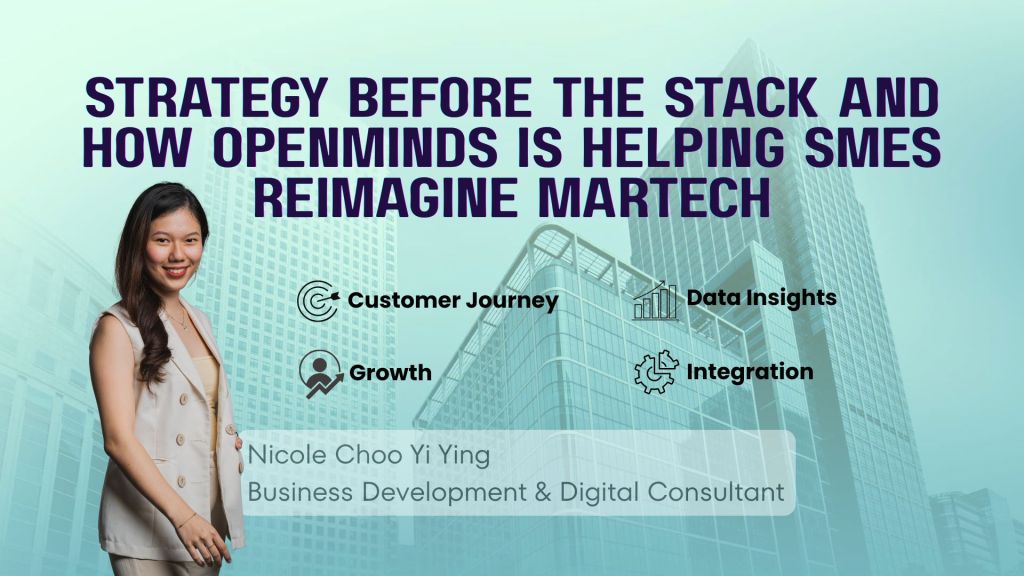
When small and medium enterprises (SMEs) hear the word “Martech”, the immediate assumption is often that it belongs to large corporations with deep pockets, sophisticated teams, and sprawling budgets. Nicole Choo, Strategic Business Development & Digital Consultant at OpenMinds, believes it’s time to challenge that narrative. As she points out, the real barriers to entry are not financial, but strategic clarity on customer needs, knowing where to begin, and ensuring the tools chosen work together rather than in silos.
The data reinforces her point. In Singapore, 82% of SMEs now use at least one digital solution for their business, up from 69% just a few years ago. Yet despite this adoption, only 21% of marketers fully utilise their marketing data and analytics, while nearly half struggle to measure ROI or integrate customer data through CRM tools. The story is similar in Malaysia, where SMEs make up 98.5% of all business establishments, but 77% remain at only basic levels of digitalisation, with just 19.7% effectively adopting online marketing. For many, lack of skills and a clear roadmap, not cost, remain the real obstacles.
Against this backdrop, Nicole’s call for “strategy before the stack” becomes even more relevant. Martech has evolved into an accessible, modular ecosystem, but without a coherent approach, it risks becoming another source of inefficiency. The opportunity for SMEs in Singapore and Malaysia is clear: to shift the conversation from affordability of tools to how these tools can be deployed with purpose, building sustainable customer engagement and long-term growth.
Busting the big-budget myth
One of the biggest myths Nicole encounters is that Martech is only accessible to giants in the industry. “That simply isn’t true anymore,” she explained. The ecosystem has matured to the point where SMEs can now tap modular, affordable, and scalable solutions. From lightweight customer relationship management (CRM) platforms to automated email systems, these tools are designed with SMEs in mind.
The real challenge is not money, but clarity. Many SMEs know they need to “go digital,” but are unsure of where to start. Without a clear understanding of customer needs and business goals, even the most cost-efficient stack can become overwhelming.
Also read: The importance of live streaming for eCommerce SMEs in Singapore
Starting with the customer journey
Nicole emphasises that the first step for SMEs isn’t to shop for software but to map the entire customer journey. Where do customers discover the brand? What touchpoints shape their decision-making? And how do they stay engaged after purchase?
For those on limited budgets, she recommends beginning with a CRM or a simple marketing automation platform. These tools provide visibility into leads, allow businesses to track engagement, and create a foundation for layering on additional solutions like social scheduling or advanced analytics. “Solve core problems first,” she advised. “Build a digital foundation you can grow from.”
Automation with a human touch
If SMEs fear that automation risks making communication cold or robotic, Nicole is quick to reassure. Automation is not about replacing human connection, but amplifying it.
By segmenting customers into categories, first-time buyers, repeat customers, or lapsed clients, SMEs can personalise interactions at scale. Messages that reflect purchase history or celebrate customer milestones transform automation from a blunt instrument into a brand voice enhancer. “Technology gives you scale,” Nicole observed, “but it’s the storytelling and personalisation that make it human.”
The strategy trap
One of the most common mistakes SMEs make is chasing tools without a strategy. Cheap or free platforms are attractive, but in the absence of integration, they often create data silos that waste time and fragment insights. Nicole notes that this is a recurring problem among small businesses in Singapore and Malaysia- a rush to adopt tools without first understanding customer journeys or business needs. The numbers bear this out. In Singapore, while 82% of SMEs now use at least one digital solution, the majority are not maximising their value, highlighting the gap between adoption and effective use.
The under-utilisation of data further illustrates the issue. A 2025 study found that only 21% of marketers in Singapore fully leverage their marketing data and analytics, despite the widespread uptake of digital platforms. Nearly half also struggle to measure ROI or integrate customer data effectively across channels, underscoring the risks of a piecemeal approach. Similarly, in Malaysia, where SMEs account for 98.5% of all business establishments, 77% remain at basic levels of digitalisation. This suggests that while digital adoption is rising, strategic alignment is lagging behind- leaving many SMEs with fragmented systems that don’t deliver meaningful insights or growth.
For Nicole, the solution is simple but often overlooked: establish a “single source of truth” for customer data and build technology stacks with integration in mind. Her mantra, “strategy before the stack,” captures this philosophy. By starting small, prioritising integrated platforms, and layering on tools only when there is a clear need, SMEs can avoid the trap of complexity. Martech, she argues, should be about simplifying operations and empowering teams to make better decisions, not adding another layer of inefficiency to already lean businesses.
The results are tangible: more efficient marketing, improved customer loyalty, and a competitive edge in markets where agility matters. “Martech isn’t about being trendy,” Nicole said. “It’s about embedding technology into strategy so it drives real outcomes.”
Beyond the tools
Nicole’s approach with OpenMinds underscores that the journey is as important as the destination. Her team begins by understanding a client’s workflows, existing data sources, and business goals. Only then do they recommend tools- a sharp contrast to the one-size-fits-all packages often marketed to SMEs.
For her, Martech is less about the shiny features of any given platform, and more about creating a digital roadmap tailored to each SME’s growth story.
A collaborative future
For SMEs in Singapore and Malaysia, the opportunity lies in moving beyond tool adoption to building integrated strategies that align with business goals. As Choo notes, starting with customer journey mapping and prioritising a single source of truth for data can help companies avoid silos and make better use of their resources.
With Martech adoption rising but under-utilisation still common, the focus for SMEs will be on turning digital investments into measurable outcomes.


 The Next Idea
Leave a comment