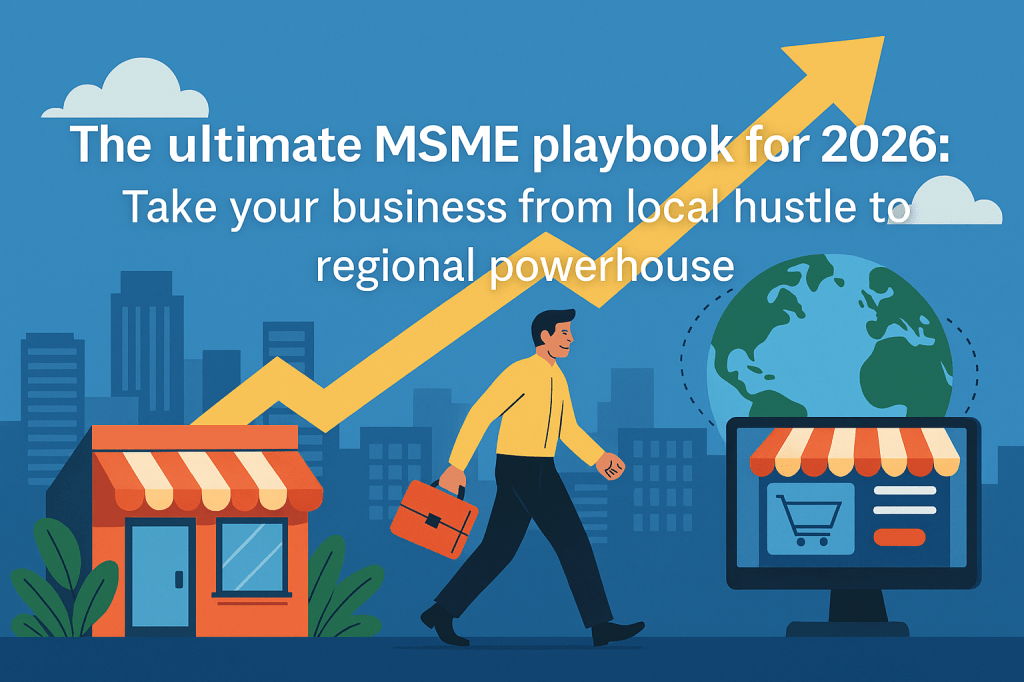
In Southeast Asia the micro, small and medium-sized enterprise (MSME) sector has quietly become one of the region’s most strategic growth engines. With more than 70 million MSMEs across the region, employing in excess of 140 million people, and contributing around 44.8 per cent of GDP, these firms power livelihoods and the economy alike.
If you are running an MSME in Malaysia or Singapore today and harbour ambitions of scaling beyond the local market, 2026 presents a golden window.
The digital infrastructure is maturing, trade frameworks are aligning and consumers are increasingly cross-border. This playbook sets out how to convert local hustle into regional impact.
Set the foundation with digital infrastructure and global readiness
The first step is to adopt the digital tools that unlock scale. In Singapore, for instance, 95.1 per cent of SMEs had adopted at least one of six digital areas, including cloud, e-payments, e-commerce, data analytics, cybersecurity and AI by 2024.
Senior Minister of State Tan Kiat How observed:
“By harnessing digital and AI tools, SMEs can punch above their weight and compete effectively on their own terms.”
This demonstrates that digital is no longer optional. In Malaysia, initiatives like the MyDIGITAL agenda and the Malaysia Digital Economy Blueprint are recalibrating the landscape for local firms to compete globally.
Actionable checklist for MSMEs looking to achieve this in 2026
- Ensure your firm has adopted at least one e-payments solution and one cloud-based tool.
- Undertake a review of your cross-border readiness: logistics, tariffs, language, regulatory compliance.
- Use digital analytics and marketing to identify neighbouring markets (for example Malaysia firms looking at Indonesia, Singapore firms looking at Malaysia/Thailand).
Leverage cross-border payments and e-commerce channels
One of the most under-exploited levers for growth is cross-border payments and platform commerce. Across ASEAN, MSMEs represent 97 – 99 per cent of all businesses and account for roughly 85 per cent of employment.
According to the World Economic Forum, while Southeast Asia is identified as a top cross-border growth opportunity in Asia-Pacific, fewer than one in five of the ~71 million MSMEs are formally organised for export-oriented trade.
In practice this means there is enormous room for firms from Malaysia and Singapore to use e-commerce platforms, regional logistics hubs and payments rails to tap new markets. For example, a Malaysian manufacturer of artisanal goods might partner with a Singapore digital-logistics hub and list on platforms selling into Indonesia or Thailand.
Actionable checklist for MSMEs looking to scale in 2026
- Choose a regional e-commerce platform or marketplace that supports multi-country logistics and payments.
- Offer localised currency and payment options (e.g. local bank transfers, mobile wallets) to reduce abandonment.
- Align fulfilment and returns logistics for the target market to build trust.
- Monitor foreign exchange exposure, tax and certification/regulation requirements in the target markets.
Map the talent and partner ecosystem for scale
Technology alone will not guarantee growth. In Singapore, in March this year, at the post-Budget discussion with Oriental Remedies Group co-founder and CEO Beatrice Liu, Xero Asia managing director Koren Wines, and Senior Minister of State for Trade and Industry Low Yen Ling as speakers with BT deputy news editor Anita Gabriel as moderator, it was noted that scale is achieved by “staying open to talent, to innovation and to trade.”
The Malaysian government’s message is similar:
“Digitalisation isn’t a luxury; it’s a necessity. We need to ensure no SME is left behind as we transition to a tech-driven economy.”
For an MSME aiming for regional growth in 2026, gearing up with the right partners is vital: cloud-service providers, regional logistics firms, payments fintechs, and bilingual/trilingual staff. Equally important is talent upskilling – your employees must be ready to operate across language, culture, compliance and digital tools.
Actionable checklist for MSMEs looking to go regional in 2026:
- Conduct an internal audit of your staff’s digital readiness: for example, comfort with analytics tools, e-payments dashboards, multi-market customer service.
- Seek partnerships: e-commerce marketplaces, regional logistic hubs, cross-border payment platforms.
- Consider regional hires or freelancers for market localisation – language, culture, compliance.
- Build processes for scalability: standardise systems so that entering a new market is a repeatable sequence rather than a bespoke project each time.
Financial and regulatory readiness: Mitigating risk, unlocking growth
Scaling regionally introduces new risks: currency volatility, tax regimes, regulatory compliance, export documentation, data protection laws. Many MSMEs still struggle with financing when expanding: across ASEAN, the financing gap remains a persistent challenge for MSMEs.
Malaysia and Singapore both recognise this. For instance, Malaysia’s Digital Economy Framework Agreement (DEFA) under the Association of Southeast Asian Nations expects to be implemented by 2026 so that smaller firms can benefit from harmonised standards and interoperable systems.
Actionable checklist:
- Seek grants or support programmes focused on digitalisation or exports in Malaysia (for example MyDIGITAL-related incentives) or Singapore (such as IMDA’s grants).
- Review currency-hedging options or design your pricing to absorb FX swings in target markets.
- Document legal/regulatory requirements in your target country: data protection, local labour law, certification/standards for products, e-commerce regulation.
- Use cloud-based accounting and compliance tools to unify reporting across markets and reduce risk of fragmentation.
Pick a target market, launch and iterate
Rather than trying to open multiple markets simultaneously, pick one adjacent but high-potential market and iterate. For a Malaysian firm the natural next step might be Singapore or Indonesia; for Singapore-based MSME, Malaysia or Thailand may make sense. That avoids complexity and allows you to refine processes before scaling further.
For example: A Singapore SME selling health-wellness products might first adapt its packaging and marketing for Malaysia, tap an e-commerce partner in Kuala Lumpur, optimise logistics and payments, then roll the same playbook to Indonesia.
Actionable checklist for choosing the market in 2026:
- Conduct a market-entry pilot: select one product, one channel, one market for initial push.
- Define measurable milestones: e.g. number of orders, customer-satisfaction score, return rate, cost per acquisition.
- Use customer feedback to refine language, pricing, offers, logistics.
- Once stable, apply the same model to a second market. Build a template.
Measure, learn and scale
Scaling is not just expansion but continuous improvement. Use digital tools to collect data: customer behaviour, payment drop-off, logistic delay, repeat purchase rate, cross-sell success. In Singapore, SMEs using AI-enabled solutions achieved average cost savings of 52 per cent in 2024.
Regular review loops allow you to stop doing what fails, double-down on what works, and allocate resources where growth potential is greatest.
Actionable checklist for business growth in a cost-efficient manner:
- Establish dashboards that track metrics by market, channel and product.
- Schedule monthly or quarterly review meetings with your team to discuss digital adoption, logistics performance, customer-feedback trends.
- Use scalable tools: cloud-based analytics, e-commerce platform reporting, regional payments dashboards.
- Reinvest a portion of incremental profit into A/B testing, localisation efforts and process refinement.
For MSMEs in Malaysia and Singapore, 2026 offers significant opportunities. The digital foundations are there. The regional trade frameworks are aligning. Consumers across Southeast Asia are ready for cross-border commerce.
The path from “local hustle” to “regional powerhouse” is achievable and repeatable if you adopt the right tools, build scalable processes, and commit to continuous learning as you move from one market to the next.
Also read: The quiet digital workforce: How Southeast Asia’s SMEs are quietly scaling with AI



 The Next Idea
Leave a comment