
January is when SMEs build plans. February is when they find out whether anyone is actually following them.
Right after the Q1 kick-off energy, a familiar pattern shows up across small teams. Leads are coming in, conversations are happening and yet deals quietly stall because follow-ups are inconsistent, manual and invisible. You rarely notice it at the moment. You notice it later, when a warm lead goes cold and no one can answer simple questions like, “Did we reply?” or “Who is supposed to chase this?”
The uncomfortable truth is that leads start leaking for a simple reason: follow-ups are still being managed manually. And speed matters more than most founders realise. The MIT Lead Response Management Study found that the odds of qualifying a lead drop 21x when response time slips from five minutes to 30 minutes. InsideSales has reported a related reality check on the ground: over 30% of leads are never contacted at all, even before you get to “nurture” sequences and closing tactics.
This is why February is such a useful month to focus on sales operations. Most SMEs do not have a sales problem. They have a follow-up problem. When the follow-up process is fragile, revenue becomes fragile too, even when demand is healthy. The irony is that closing is often less about brilliance and more about persistence. Reports suggest that 80% of sales typically require around five follow-up calls, yet many teams still behave as if one message is enough. That gap between what deals require and what teams actually do is exactly where the pipeline quietly disappears.
That is also why this month’s tool choice is practical rather than aspirational.
Tool of the month: HubSpot CRM(Starter Edition).
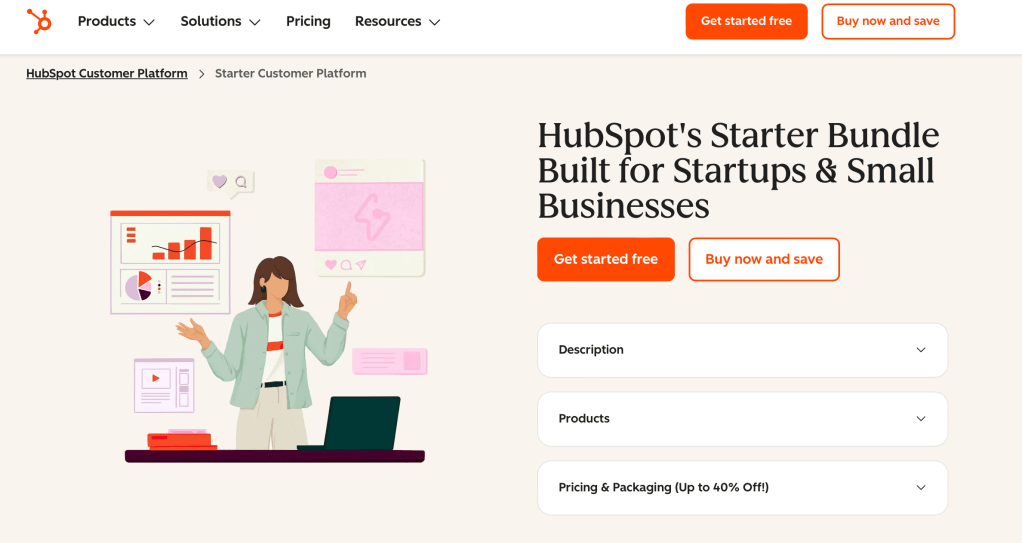
Not because founders “need a CRM” or because every business should run a pipeline like a multinational. But because under-20-person teams need a lightweight system that protects follow-up discipline before follow-up decay becomes a habit.
Why follow-ups break in February
By February, the enthusiasm of a January plan meets reality. Leads are scattered across WhatsApp, email threads, DMs and spreadsheets. Follow-ups sit in someone’s head or worse, in a personal calendar. If the salesperson is also the founder, daily firefighting takes over. If two people touch the same lead, ownership gets blurry fast.
None of this looks dramatic day to day. It is not a single disaster. It is a slow drip of loss.
A follow-up problem is rarely about effort. It is about memory, visibility and cadence. When a team cannot see what is happening, they cannot correct it. When they cannot build a simple rhythm, they cannot sustain it.
What matters in a small-team CRM is not advanced features. It is a set of basics that are easy to use consistently: simple pipelines, email tracking, reminders and a realistic cost vs value payoff for lean teams.
What a small-team CRM should actually do
Most SMEs do not need a system that can model 14 deal stages and eight approval workflows. They need a system that helps them do five boring things consistently, without turning selling into admin.
First, it should make ownership obvious. If no one is clearly responsible for a lead, the lead is already at risk. Second, it should force the next step. If follow-up timing is random, deals slow down. Third, it should make communication visible so replies do not disappear into private inboxes. Fourth, it should keep deal status in one place so the pipeline is not trapped in someone’s head. Finally, it should create a feedback loop so the team can review what is working weekly, not only when a month feels “quiet”.
This is the difference between a CRM as a database and a CRM as a behaviour system.
And that is the real point most SME teams miss: CRMs fail when they are treated as a place to store information later, instead of a place to manage action now. If founders do not use a CRM daily, it will not become real for anyone else.
HubSpot Starter, reviewed the way SMEs should review it
1) CRM basics without enterprise bloat
The best CRM for a small team is one person will actually open.
Your goal in month one is not perfect data. It is a single source of truth for four things: who the lead is, where they came from, what stage they are in and what happens next. If a CRM requires too much admin, it becomes a guilt tool. If it is light enough to update in under a minute, it becomes a habit.
2) Email tracking and reminders
For most SMEs, email follow-ups are the highest leverage fix.
The issue is not writing a follow-up email. It is knowing whether it was opened, whether it was replied to and whether a next touchpoint is scheduled. When that information is scattered across inboxes, follow-ups become a best-effort exercise. When it is visible, follow-ups become a system.
A simple rule shifts behaviour fast: every interaction ends with a logged next step and every next step has a date. Implement only that and many teams see improvement quickly because selling stops depending on memory.
3) Simple pipelines for small teams
Small teams often avoid pipelines because they feel “too corporate”. But a pipeline is not corporate. It is just a shared language.
A lightweight pipeline prevents the most common friction conversations: “Is this lead still active?”, “I thought you were following up”, “We sent a quote, right?” Your pipeline does not need to be clever. It needs to be stable.
A practical starting point is enough: New lead, Contacted, Meeting booked, Proposal sent, Negotiation, Closed won, Closed lost. You can refine later. Discipline comes first.
4) Cost vs value for under-20-person companies
This is where founders should be honest.
A starter CRM pays off when more than one person touches leads, inbound interest is growing, forecasting matters or follow-ups are already slipping and you can feel it in revenue timing. If you have five leads a month and one person handling them, a spreadsheet can work. If you have thirty leads a month across multiple channels, you are already paying for leakage. You just cannot see it yet.
The real test: Will the founder use it daily?
Most CRM reviews skip this, but it is the entire game.
If the founder never opens the CRM, no one else will treat it as real. If the founder checks it once a month, the data will already be wrong. If the founder treats the CRM as admin, the team will too.
So the strongest way to implement a tool like HubSpot Starter is to build a simple founder routine.
A practical one is a 12-minute daily habit: check today’s tasks and overdue follow-ups, scan deals with no next step, review new inbound leads and update only what matters: stage, next step, date. It is small enough to maintain, but consistent enough to change outcomes.
A simple February setup checklist
If you are rolling this out in February, keep the build small and bias towards speed. Create your basic pipeline stages. Define what “next step” means for your team, whether that is an email, call, meeting or proposal. Connect the core email accounts used for selling. Decide one rule: no deal can sit without a next step date. Then run a weekly 20-minute pipeline review.
You are not setting up “a CRM”. You are setting up a follow-up rhythm.
Bottom line
Most SMEs do not need more leads. They need fewer leads falling through gaps.
February is when those gaps become visible. A tool like HubSpot CRM Starter fits because it gives small teams the basics that matter: tracking, reminders, simple pipelines and a realistic value story. But the tool is not the win. The win is the behaviour shift, a sales culture where every lead has a clear owner, a visible next step and a cadence that does not depend on memory.
If your follow-ups are currently held together by good intentions, February is the month to stabilise them.
Also read: AI without the overwhelm: How SMEs can use one AI tool to replace 5 workflows



 The Next Idea
Leave a comment