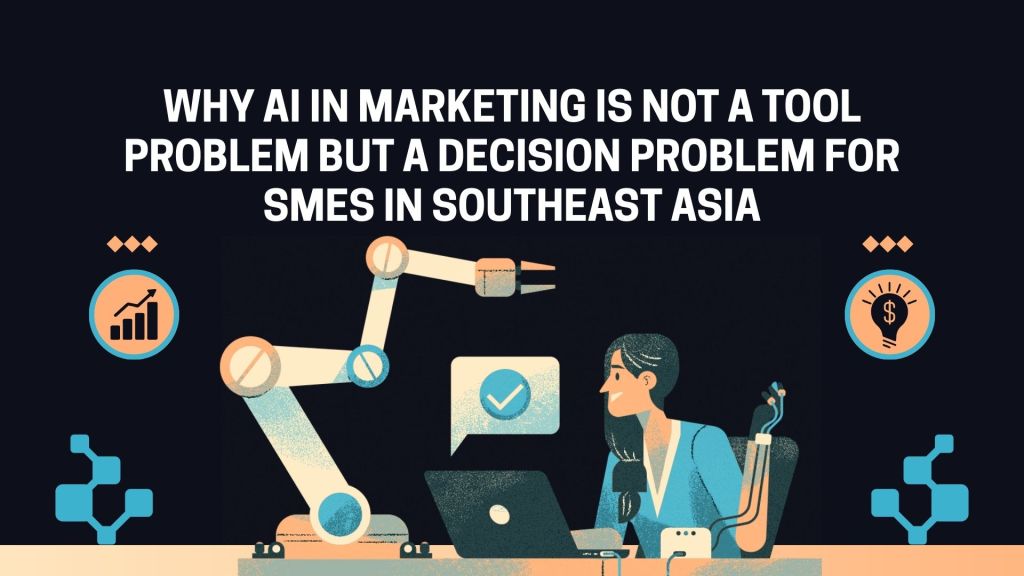
For most small and mid-sized businesses, the conversation around AI in marketing still starts in the wrong place. It starts with tools. Which AI copywriter should we use? Which SEO platform is best? Should we automate email campaigns?
These are valid questions, but they miss the more important shift. AI is not fundamentally changing what marketing does. It is changing how quickly decisions are made, how confidently they are made, and who gets to make them.
For SMEs across Southeast Asia, where teams are lean and margins are tighter, this shift is not just operational. It is strategic.
The quiet pressure SMEs are already under
AI adoption is no longer early-stage experimentation. It is becoming a baseline. Global projections suggest AI adoption is growing at over 37% annually through 2030. More importantly, adoption is no longer concentrated in large enterprises. Smaller businesses are increasingly using AI not because they want to innovate, but because they cannot afford to fall behind.
In marketing specifically, over 60% of marketers have already integrated AI into their workflows, and nearly 90% believe they need to increase usage to stay competitive. For SMEs, this creates a subtle but real pressure. The competitive baseline is shifting faster than internal capabilities can catch up.
This is where many founders make mistakes. They treat AI adoption as a feature upgrade rather than a capability shift.
From execution bottlenecks to decision velocity
Traditionally, marketing bottlenecks in SMEs were execution-driven. Content took too long to produce. Campaigns required manual coordination. Insights came late, often after the budget had already been spent.
AI changes this by compressing execution time. Tasks like keyword research, campaign planning, content drafting and reporting can now be partially automated. In many cases, teams report saving several hours per task, with some workflows becoming nearly real-time.
But the real shift is not time saved. It is what happens next. When execution becomes faster, decision-making becomes the new bottleneck. Should we target this segment? Should we shift the budget to this channel? Is this campaign actually working?
AI does not remove these questions. It amplifies them by surfacing more data, faster. For SMEs, the challenge is no longer “Can we execute?” but “Can we decide well, quickly, and consistently?”
Personalisation is no longer optional. It is expected
One of the most visible impacts of AI in marketing is the move towards hyper-personalisation.
Consumers now expect experiences tailored to their preferences, behaviours and context. This is no longer limited to large platforms like Netflix, which dynamically adjusts content recommendations and even visual previews based on user behaviour.
That level of personalisation is now filtering down to SMEs. Email campaigns are expected to reflect user behaviour. Social content is expected to feel relevant. Ads are expected to reach the right audience at the right moment.
AI enables this by analysing behavioural patterns, segmenting audiences and predicting preferences at scale. For SMEs, the implication is clear. Generic marketing is becoming invisible.
However, personalisation introduces a second-order challenge. The more tailored the experience, the more data dependency increases. And with that comes responsibility.
The data trust gap SMEs are underestimating
Most SME conversations around AI focus on efficiency gains. Far fewer focus on data integrity and trust. AI systems are only as reliable as the data they are trained on and the assumptions they are built around. Poor data quality leads to poor targeting, misleading insights and ultimately wasted spend.
In Southeast Asia, where businesses often operate across fragmented systems, this becomes a real risk. Customer data may sit across spreadsheets, CRM tools, messaging platforms and e-commerce systems. Without alignment, AI outputs can create a false sense of confidence.
This is where SMEs often become over-reliant on AI-generated insights.
The system suggests a segment is high-performing. The team reallocates the budget. Results underperform. No one can fully explain why. The issue is not the tool. It is the underlying data structure. For SMEs, investing in AI without investing in data hygiene is like scaling marketing on unstable foundations.
Automation does not replace thinking. It exposes gaps in it
There is a persistent concern among SME teams that AI will replace human roles, particularly in content and marketing. In practice, the opposite is happening. AI handles repetitive tasks, from drafting content to analysing data patterns.
This frees up time, but it also exposes a gap. Teams now need stronger strategic thinking, not less.
If AI can generate ten campaign ideas in seconds, which one should you choose?
If AI suggests multiple audience segments, which one aligns with your business goals?
If AI predicts campaign outcomes, how do you validate those assumptions?
These are not technical questions. They are judgement calls. This is why many SMEs feel overwhelmed despite having access to powerful tools. The problem is not capability. It is clear.
Where SMEs are getting it right
Across Southeast Asia, some SMEs are beginning to approach AI differently. Instead of starting with tools, they start with constraints.
They ask:
- Where are we spending the most time on low-value tasks?
- Where are we making decisions with incomplete data?
- Where are we consistently reacting instead of planning?
From there, AI becomes a targeted intervention rather than a broad adoption effort. For example, using AI for media monitoring can replace hours of manual tracking by analysing brand mentions across platforms and identifying sentiment in real time.
Similarly, AI-driven SEO tools can continuously analyse search trends and competitor activity, allowing SMEs to adapt content strategies without extensive manual research. The difference is subtle but important. These businesses are not asking, “What can AI do?” They are asking, “Where are we currently inefficient or blind?”
The real shift: Marketing as a continuous system
Before AI, SME marketing often operated in cycles. Plan. Execute. Measure. Adjust. Each stage took time. Feedback loops were slow. AI compresses this into something closer to a continuous system.
Campaigns can be adjusted mid-flight. Content can be optimised in real time. Audience targeting can evolve dynamically. This creates an advantage for SMEs who can move quickly. Unlike large organisations, they are not constrained by layers of approval or rigid systems.
But it also requires a mindset shift. Marketing is no longer a series of campaigns. It is an ongoing, adaptive system.
One lesson for SMEs building with AI
The biggest mistake SMEs can make is treating AI as a shortcut. It is not. AI does not remove the need for strategy. It makes weak strategy more visible.
The SMEs that will benefit most are not the ones using the most tools. They are the ones making clearer decisions, grounded in better data, and moving faster with intent. In that sense, AI is not a marketing upgrade. It is a forcing function. And for SMEs willing to engage with that shift, it may be the most important one they navigate in the next decade.
Also read: How OtterHalf is helping SMEs rethink marketing in 2026
 The Next Idea
Leave a comment