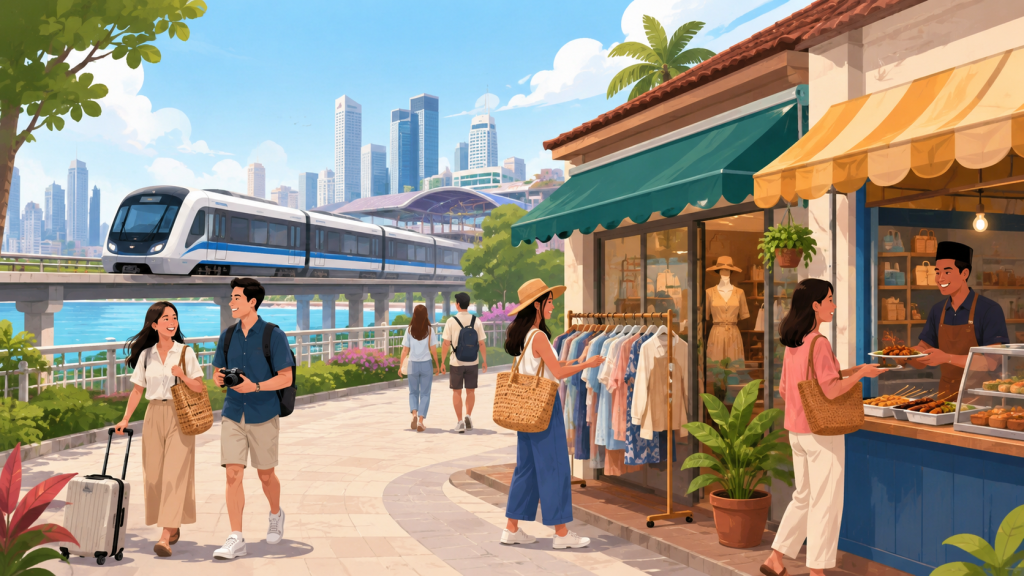
When the Johor Bahru–Singapore Rapid Transit System Link begins passenger services, it will do more than shorten journeys across the Causeway. It could reshape where Singapore residents shop, eat, seek services and spend their weekends.
A recent study reported by CNA estimates that Singapore consumers could make 11.2 million additional round trips to Johor Bahru each year after the RTS Link opens, representing a 51 per cent increase in outbound journeys. Their additional annual spending in Johor Bahru could exceed S$1 billion. Visitors travelling in the opposite direction are also expected to spend more, although the study projects a net increase in spending flowing from Singapore into Malaysia.
The RTS Link is scheduled to begin operations around the end of 2026 or January 2027. It will connect Woodlands North in Singapore with Bukit Chagar in Johor Bahru and will have the capacity to carry up to 10,000 passengers per hour in each direction. Co-located immigration facilities will allow passengers to clear both countries’ border controls before departure, removing one of the biggest sources of uncertainty from cross-border trips.
For Malaysian small and medium-sized enterprises, this is a significant opportunity. However, increased footfall will not automatically translate into rising profits. Malls, international retailers and established chains will be competing for the same customers. SMEs will need to make themselves easier to discover, more convenient to visit and more memorable once customers arrive.
Compete on discovery before competing on price
Many Singapore visitors will plan their trips before they board the train. They will search Google Maps, TikTok, Instagram, Xiaohongshu and travel platforms for restaurants, salons, activities, clinics, shops and services near the station.
This means an SME’s first competitive battlefield is not the shopfront. It is the search results page. Businesses should ensure that opening hours, addresses, prices, menus, booking links and contact details are accurate across digital channels. Photographs should show what customers can realistically expect rather than relying on heavily edited promotional images. Reviews should be answered regularly, including negative ones, because a thoughtful response can demonstrate reliability to future customers.
Content should also be designed around visitor intent. Instead of posting only general product images, businesses can answer practical questions such as how far they are from Bukit Chagar, whether appointments are required, which payment methods are accepted and how much time customers should allocate.
A pottery studio, for example, could promote a two-hour workshop that fits into a day-trip itinerary. A salon could offer online appointment slots aligned with expected train arrival periods. A café could publish a walking route from the RTS station and suggest nearby independent businesses to visit afterwards.
This approach matters because tourists do not only purchase products. They purchase certainty, convenience and a complete use of their limited time.
Build an experience that large chains cannot easily copy
Price differences and favourable exchange rates will remain part of Johor Bahru’s appeal, but competing entirely on affordability is risky. Larger companies usually have more room to discount, advertise and absorb rising costs.
Independent businesses should instead focus on what chains struggle to replicate: local knowledge, personal service, cultural identity and distinct experiences.
A small food business can explain the history behind a regional dish. A craft retailer can offer personalisation or short demonstrations. A heritage shop can package its history into a guided tasting, workshop or neighbourhood walk. Wellness businesses can provide consultation-led services rather than selling generic packages.
Johor’s heritage businesses may be particularly well positioned to benefit from growing interest in experiences that feel specific to the city. However, these businesses are also under pressure. Retail demand in southern Johor Bahru has already been rising in anticipation of the RTS Link and the Johor-Singapore Special Economic Zone, contributing to concerns about rents and the survival of older independent businesses.
SMEs therefore need to turn their identity into a commercial advantage before rising costs force them to compete on landlords’ terms. Authenticity is valuable, but it must be made visible, bookable and easy to understand.
Partner to move tourists beyond the malls
One independent business may struggle to persuade a visitor to leave the immediate RTS and mall corridor. A group of businesses can create a destination.
Restaurants, cafés, workshops, retailers and accommodation providers can develop shared itineraries, neighbourhood maps, bundled offers and referral programmes. A café might offer a discount to customers who show a receipt from a nearby independent bookstore. A boutique hotel could recommend local dining and wellness partners. Transport operators could package trips from Bukit Chagar to districts such as Mount Austin, Iskandar Puteri, Desaru or Kota Tinggi.
These partnerships can help spread visitor spending beyond the largest retail developments and reduce the dependence of smaller businesses on expensive locations near the station.
They can also encourage longer stays. A visitor who initially plans to shop for a few hours may stay overnight if businesses collectively offer enough dining, entertainment and family activities. Increasing the length of a visit is often more valuable than simply increasing the number of visitors because it creates more opportunities for spending across accommodation, food, retail and services.
Capture customer data, not just transactions
The greatest mistake SMEs could make is treating each RTS visitor as a one-off sale. Businesses should create simple reasons for customers to return. These could include digital loyalty programmes, WhatsApp updates, birthday rewards, advance booking benefits or products that can be reordered online from Singapore.
The aim should be to obtain customer consent to continue the relationship after the visit. A restaurant could invite customers to join a dining club for seasonal menu announcements. A beauty business could send reminders when a follow-up treatment is due. A specialty food producer could offer cross-border delivery or collection during the customer’s next trip.
Businesses should also track which channels bring in visitors, what customers purchase and whether promotions generate repeat visits. A busy weekend does not necessarily mean a profitable one. Discounting, overtime and platform commissions can increase revenue while weakening margins.
The metrics that matter include average transaction value, gross margin, repeat-visit rate, customer acquisition cost and revenue per operating hour.
Prepare for the risks of rapid growth
The RTS opportunity will also bring pressure. More businesses may compete for prime retail locations, pushing rents higher. Larger brands may offer better salaries and make it harder for SMEs to retain workers. Congestion could move from the Causeway to local streets, parking areas and popular neighbourhoods.
Businesses should avoid expanding fixed costs based only on optimistic visitor forecasts. Rather than immediately taking a larger outlet, an SME could test demand through pop-ups, shared retail spaces, mobile services, pre-orders or appointment-based operations.
Workforce planning will be equally important. SMEs may need to redesign roles, simplify menus, automate bookings and cross-train employees before visitor numbers rise. A business that attracts more customers but cannot serve them consistently risks damaging its reputation at the moment it receives the most attention.
A national lesson, not only a Johor Bahru opportunity
The RTS Link may be the immediate catalyst, but the broader lesson applies across Malaysia. Better transport connectivity, Visit Malaysia 2026 and the recovery of regional tourism are creating opportunities for SMEs in Kuala Lumpur, Penang, Melaka, Ipoh, Sabah and Sarawak.
Malaysia received just over 25 million international tourists in 2024, with Singapore contributing approximately 9.1 million visitors, making it the country’s largest source market. Tourism generated RM291.9 billion and accounted for 15.1 per cent of Malaysia’s economy in 2024.
MSMEs already contribute 39.5 per cent of Malaysia’s GDP and employ 8.1 million people. Their service exports also rose sharply in 2024, supported partly by the recovery in travel-related activity.
The opportunity, therefore, is not simply to capture Singapore dollars near Bukit Chagar. It is to build stronger tourism-facing SMEs across the country.
The RTS Link can bring customers closer. It cannot make businesses distinctive, discoverable or resilient. Malaysian SMEs that invest now in digital visibility, local partnerships, operational capacity and customer retention will be better placed to turn an infrastructure opening into sustained profit growth. Those that rely only on increased footfall may find that the crowds arrive, but most of the value flows elsewhere.
Also read: Why ransomware is becoming a business survival issue for Southeast Asian SMEs



 The Next Idea
Leave a comment