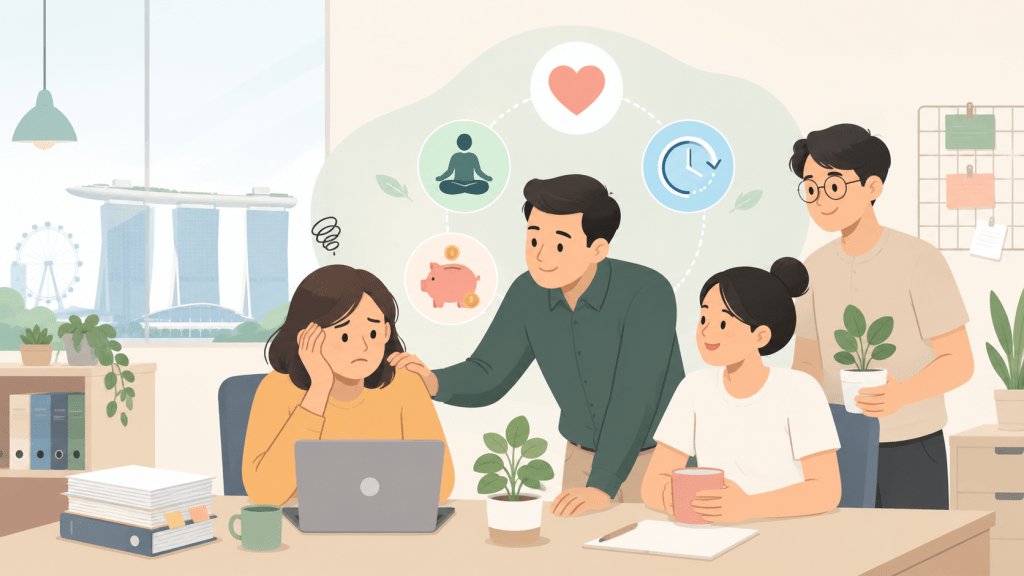
Workforce expectations are shifting. Employees today not only prioritise monetary gains when making employment decisions but are increasingly focused on factors such as work-life balance and workplace mental health support. Randstad’s 2025 report on Singapore’s workforce has shown that 71% of job respondents consider mental health support as universally important when making job choices.
For many small and medium-sized enterprises (SMEs), this incites an uncomfortable question. With numerous SMEs in Singapore already burdened by simultaneous financial pressures, the growing need for SMEs to devote resources towards implementing greater mental health measures adds another layer to the “hidden cost” crisis they are facing.
Moreover, resource-strapped SMEs may find it difficult to replicate the numerous benefits and programmes offered by multinational companies (MNCs) without sacrificing output and productivity. The answer is not to choose between the two. Instead, SMEs in Singapore can reposition themselves to adopt low-cost practical strategies as well as leverage government measures to respond to shifting workforce expectations.
The business cost of mental health
These rising demands for greater mental health initiatives and work-life balance are not unwarranted. Four in ten employees in Singapore have reported facing high mental health risks, while numerous younger employees already struggle with symptoms of depression, anxiety or stress as they enter the workforce. These stresses can carry a high business cost for lean SMEs with limited spare capacity, manifesting through repeated absenteeism, reduced productivity and morale, as well as high turnover rates.
Singapore’s Ministry of Manpower notes that workplace stress can arise from high workload and work pace as well as limited boundaries between work and home. In the face of this, the Tripartite Advisory on Mental Well-being at Workplaces has illustrated how these business costs can be supplanted with a healthy working environment which can boost productivity. As such, for SMEs, the objective is not to remove all pressures from employees. Instead, it is to prevent ordinary work demands from becoming chronic and unmanageable.
Fix workplace structures before implementing wellness benefits
Workplace mental health is often discussed through the language of benefits. Companies are known to implement wellness subscriptions and assistance programmes to improve employees’ mental health. For SMEs, increasing wellness benefits will not compensate for underlying workplace practices which may cause unnecessary stress.
Instead, SME founders should first look at the root of workplace pressures. Are workloads overly concentrated among a few reliable employees? Are employees expected to remain contactable outside working hours despite there being no genuine emergency? Issues such as these can often be addressed without large additional spending.
Instead, teams can implement small practices which can tangibly improve employees’ daily experience. These include founders laying down clear guidelines to distinguish between true operational emergencies and tasks that can wait till the next working day. Managers can also conduct weekly or bi-weekly check-ins on employees to gauge how they are handling their current workload and if any form of support or adjustments are needed.
Moreover, responsibilities should also be clear. In lean companies such as SMEs, employees often take on various functions, leading to confusion and repeated effort at times. A simple responsibility list covering projects and expected roles each employee is taking charge of can curb this uncertainty. Before spending additional cost towards mental health programmes, SME founders should first look internally to see if a change in culture can lessen workplace pressures.
Offer flexibility around the job, not the location
One of the key strategies adopted by firms to enhance workplace conditions and boost work-life balance is through offering flexible work arrangements such as weekly work from home days. Yet, for many SMEs such as those in the hospitality, retail or manufacturing sector, such arrangements could be difficult to implement as job functions require on-site work. Nonetheless, flexibility can also involve time, scheduling and job design.
A retail business can allow employees to exchange shifts through a defined process. A hospitality business can publish rosters earlier. While a manufacturing firm can allow staggered start times. These arrangements must still meet business needs, and flexibility does not mean SME founders have to approve every single employee request.
SME founders can thus utilise the Tripartite Guidelines as guardrails to establish a formal process and written policy. This will allow them to properly consider requests for greater job flexibility and respond accordingly depending on business and employee needs. Consistency and clear communication are essential for SMEs. Employees should know what options are available, how to request them and why a certain call for greater flexibility may be refused.
Leverage government support before creating programmes from scratch
Before spending to implement new mental health programmes, SME founders should also check what existing public resources they can leverage to reduce the cost of building a workplace mental health programme from the ground up.
For example, the free iWorkHealth tool developed by the Ministry of Manpower alongside medical institutions such as the Health Promotion Board and the Institute of Mental Health allows companies to assess employee well-being and identify common workplace stressors. The results can help SME founders implement more targeted and impactful initiatives instead of overspending.
Other government initiatives such as the Total Workplace Safety and Health Programme provide SMEs with free mental well-being workshops to teach staff members how they can manage their physical and mental health. Employers can also appoint a workplace mental well-being champion to coordinate resources and establish referral procedures. These individuals can tap into the government-initiated Champions Network, which provides them with workshops and resources to implement this mental well-being system.
SMEs benefit from these tools as they would not require the company to employ a dedicated team of specialists or start wide-scale programmes from scratch. Nonetheless, government support should not replace internal change. While government programmes can provide SMEs with an affordable springboard towards a better work environment, they cannot fully change toxic underlying company cultures.
Ensure changes are measured and sustainable
Mental health initiatives are often judged by their participation rates. These figures, however, do not tell if actual working conditions have improved. Instead, SMEs should track indicators connected to daily operations. Indicators can include staff absentee rates, turnover rates, overtime, missed deadlines or customer complaints. Short anonymous surveys can also be implemented to measure if changes made to workload or flexible work requests are effective for employees.
All these allow founders to identify workplace patterns and ensure measures have long-term impact in creating a healthier and productive workplace environment. If a certain team still has a much higher turnover rate than others, founders can also implement more targeted change and look into the workload distribution or a specific manager’s behaviour.
Connecting mental health with productivity indicators thus allows the discussion to be reframed from whether a company is being generous towards how a company is ensuring its employees can perform sustainably.
A healthier workplace does not need to be expensive
While SMEs will rarely be able to compete with MNCs through the size of their employee wellness benefits, they can compete through clarity, fairness and accessibility. Smaller companies often have leaders positioned closer to daily operations who can ensure changes are implemented more quickly as compared to larger companies.
Founders can simplify approval processes and establish new practices without an extended bureaucratic approval process. The most effective mental health strategy for SMEs may therefore look less like implementing attractive corporate wellness programmes and more like better executive management. Changes made should also address key workplace stresses directly and sustainably rather than let them develop through confusion, excessive workloads or silent burnout.
After all, changing workforce expectations are unlikely to disappear, and companies that treat them like unreasonable demands may face high long-run productivity costs. SMEs do not need large MNC-level budgets to create a healthier work environment. They need practical systems that look out for the well-being of employees while making sustainable performance possible.
Also read: Why Singapore SMEs should see Johor as a growth bridge, not just a cheaper backyard




Leave a comment