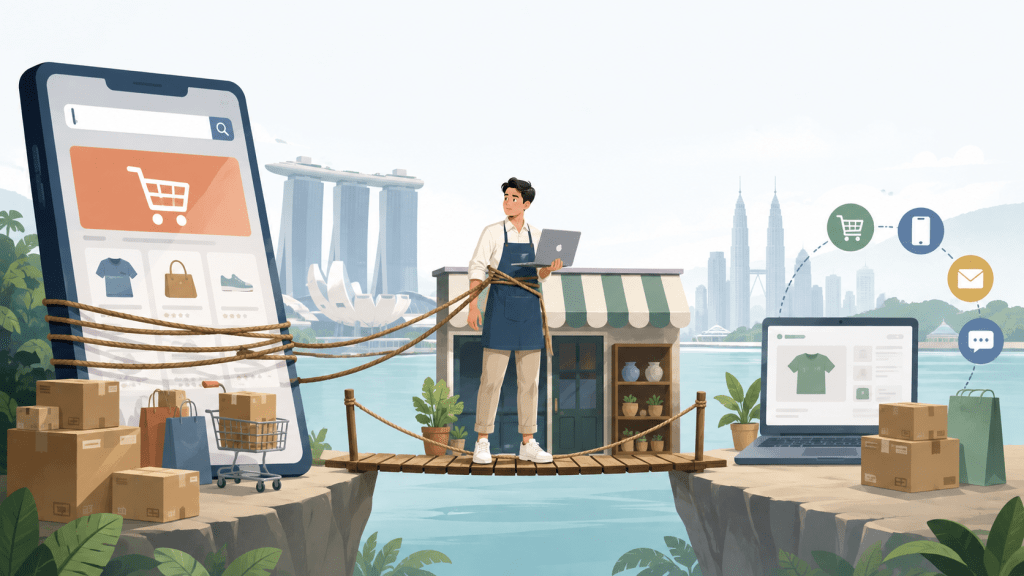
For a small business, selling through an online marketplace can feel like one of the easiest growth decisions to make. Instead of investing heavily in a physical retail presence or building an audience from scratch, an SME can list its products on an established platform and gain access to shoppers, payment infrastructure, logistics options and promotional tools almost immediately.
In Singapore, online marketplaces have become an important part of the retail landscape. FedEx notes that marketplaces are a significant driver of e-commerce growth, offering SMEs reach, built-in consumer trust and relatively low barriers to entry. Malaysia is seeing similar momentum. The country’s e-commerce market is projected to grow by 9.4% to US$37.8 billion in 2026 after estimated growth of 13.4% in 2025, while around 2.43 million Malaysian SMEs went online between 2016 and 2024.
For SME owners, therefore, the question is not whether online marketplaces are valuable. Clearly, they are. The more important question is what happens when a useful sales channel quietly becomes the business’s entire growth strategy.
When convenience becomes e-commerce dependence
There is an important distinction between using a marketplace and depending on one. Consider an SME that generates 70 or 80% of its online sales through a single marketplace. The business may appear healthy. Orders are arriving, marketing campaigns are running and revenue is growing. However, much of that growth is taking place on infrastructure the SME does not control.
The platform determines how products are discovered and can change its search algorithm, advertising system, commission structure, seller policies or promotional mechanics. It can also influence how prominently a seller appears alongside hundreds of competitors. A business that has built most of its operations around one marketplace therefore carries a concentration risk similar to relying too heavily on a single major customer or supplier.
If the platform changes its policies, raises fees or adjusts the way products are ranked, an SME may have little leverage. This is one of the potential dangers of e-commerce dependence that can easily be overlooked while sales are growing.
SMEs may be building sales without building customers
Perhaps the biggest long-term weakness of marketplace dependence is that generating a transaction is not the same as developing a customer relationship. On a marketplace, consumers often remember where they bought a product rather than who sold it. A shopper might say that they purchased something “on Shopee” or “on Lazada”, even if the actual product came from an independent Malaysian or Singaporean brand.
That distinction matters because the SME may fulfil the order while the marketplace owns much of the customer journey, from product discovery and recommendations to payments and repeat visits. Businesses can therefore find themselves repeatedly paying to reach consumers they have already served.
For SME owners, the goal should be to use marketplaces for customer acquisition while gradually developing customer relationships beyond them. Where platform rules allow, packaging can introduce customers to the brand’s website, after-sales communication can encourage them to join a loyalty programme or mailing list and social media can give them a reason to engage with the brand outside a single transaction.
Over time, this helps the business build assets that it owns directly, including its brand, audience, first-party customer relationships and community. These become increasingly valuable if marketplace conditions change.
Marketplace promotions can hide weak margins
Another risk is profitability. Marketplace sales can encourage SMEs to focus heavily on order volume because the numbers are highly visible: units sold, rankings, campaign performance and conversion rates. Yet a large number of orders does not necessarily translate into a financially healthy business.
Marketplace commissions, advertising costs, delivery subsidies, discounts, vouchers, returns and participation in major sales campaigns can gradually eat into margins. The danger becomes greater when businesses begin competing primarily on price. An SME may participate in one promotion because its competitors are doing so, followed by another because customers have become accustomed to discounts. Eventually, it can become difficult to sell at the normal retail price.
Owners should therefore assess marketplace performance using contribution margin rather than gross sales alone. For every major sales channel, they should understand how much money remains after platform fees, advertising, fulfilment, promotions, returns and payment costs have been taken into account.
A marketplace generating RM500,000 or S$150,000 in annual sales may look impressive on paper. The more useful question is how much of that revenue is actually contributing to the company’s profit.
There is also a cash-flow problem behind the checkout button
E-commerce has made paying extraordinarily simple for consumers. The same cannot always be said about receiving those payments as a small business. Research published by 2C2P by Antom in 2026 highlighted payment infrastructure as a continuing challenge for Southeast Asian SMEs, including high fees, slow settlements and limited payment options.
Singapore SMEs have reported similar pressures, including high fees, slow payouts or settlements and payment systems that are not sufficiently optimised for mobile transactions. These problems can create an uncomfortable mismatch for growing businesses. An SME may be processing more orders than ever while simultaneously facing greater pressure on working capital.
Suppliers and employees still need to be paid, inventory must be replenished and marketing expenses continue to accumulate, while marketplace revenue may not reach the business at exactly the same speed. This payment bottleneck becomes particularly important during major sales periods, when order volumes can rise sharply over a short period.
SME owners should therefore treat settlement times as part of their cash-flow planning rather than simply as a payment-processing issue. Maintaining an appropriate working-capital buffer, understanding the settlement timetable of each sales channel and avoiding excessive dependence on a single payment provider can help reduce the risk.
Businesses operating across Singapore and Malaysia should also consider whether their payment infrastructure supports the methods customers actually prefer. In Singapore, for example, digital wallets accounted for 39% of e-commerce transaction value in 2024, while credit cards remained the largest payment method at 50%. The objective is not necessarily to offer every payment method available, but to remove unnecessary friction for customers without creating an overly complicated payment system for the business.
Diversification does not mean abandoning marketplaces
Reducing e-commerce dependence does not mean leaving online marketplaces. For many SMEs, doing so would mean voluntarily walking away from one of their strongest sources of demand. Instead, businesses should think about building a portfolio of channels, each serving a different purpose.
A marketplace can be highly effective for discovery and customer acquisition, while a company’s own website can provide greater control over branding, customer data and margins. Social commerce can help create direct engagement with an audience, while physical retail, pop-ups, distributors or B2B partnerships can provide additional sources of revenue.
The right mix will be different for every SME. A small home-grown beauty company may combine marketplaces with TikTok, its own online store and occasional retail pop-ups. A Malaysian food manufacturer might use marketplaces for consumer sales while developing wholesale relationships with retailers. A niche B2B supplier may discover that its website and direct sales team ultimately generate more valuable customers than any marketplace.
The objective is not to be present everywhere. SMEs have limited time, budgets and manpower, so spreading resources across too many channels can create its own problems. The goal should instead be to develop enough diversification that the company is not dangerously exposed to a change on any single platform.
Five questions every SME owner should ask
One simple way for SME owners to assess their exposure is to imagine that their largest marketplace disappeared tomorrow. Would customers know where else to find the brand? Does the business have an independent customer database? Could customers still place orders and make payments through another channel? Would alternative revenue streams be sufficient to keep the business operating?
Owners should also ask whether they know which channels generate their most profitable customers, rather than simply the greatest number of transactions. A marketplace might be responsible for the largest share of sales while another channel generates stronger margins, more repeat purchases or more valuable long-term customer relationships.
If an SME cannot answer these questions confidently, its dependence on online marketplaces may be greater than its headline sales figures suggest.
Build on the marketplace, not underneath it
Singapore’s broader economy is becoming increasingly digital. IMDA reported that 95.1% of SMEs had adopted at least one digital area in 2024, illustrating how deeply technology has become embedded in everyday business operations. Malaysia’s rapidly expanding e-commerce economy tells a similar story. Digital channels are no longer peripheral to SME growth. They are increasingly part of the basic infrastructure of doing business.
That makes avoiding online marketplaces neither realistic nor desirable. However, SMEs should distinguish between digitalisation and dependency. A business can embrace e-commerce enthusiastically while still protecting itself against platform concentration risk.
The strongest SMEs will use marketplaces for what they are particularly good at: providing reach, convenience, infrastructure and access to customers. At the same time, they will gradually build what a marketplace cannot guarantee them, including direct customer relationships, multiple revenue channels, greater control over their brand and enough financial resilience to respond when circumstances change.
E-commerce should help an SME build a stronger and more scalable business. It should not become the single point on which that business depends.





Leave a comment